- INSPIRE White Paper
NeoFlow® VT Ventilator Circuit with Helical Wire: Performance Evaluation in the UK Market
- Product Featured: NeoFlow®
Scope
This paper discusses the UK market evaluation of the Eakin Healthcare NeoFlow® VT ventilator circuit containing the new heated helical wire within the inspiratory limb conducted from December 2025 – August 2026.
Background
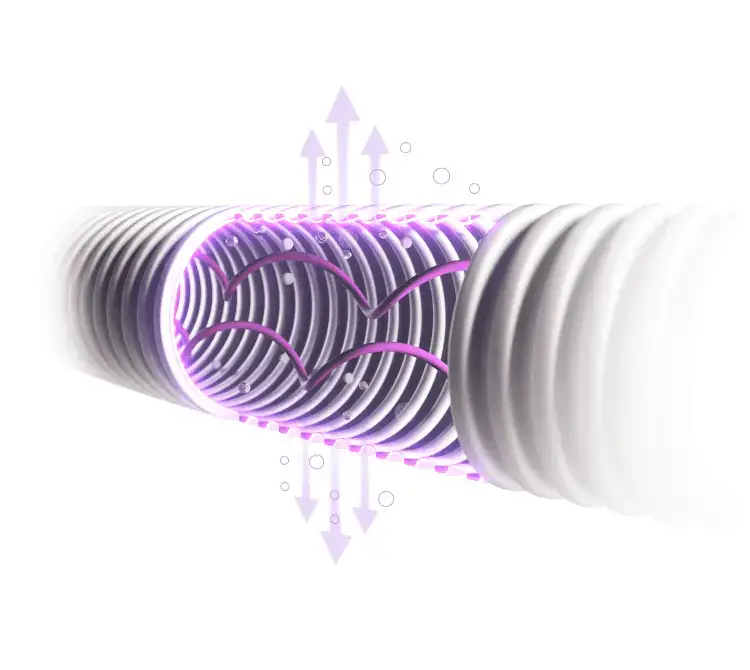
This evaluation follows the initial Turkish market investigation where condensation concerns were identified with the previous circuit configuration. Following the investigation of these issues, the helical wire configuration was introduced as an alternative to the previous straight (rectilinear) design, with the aim of improving condensate (i.e. rainout) control during clinical use. The updated circuit was then evaluated in five Turkish hospitals and received positive feedback. The UK evaluation has therefore been undertaken to build on the findings from the Turkish market and to determine whether similar performance benefits are observed in domestic clinical use.
Objectives
Primary objectives
- Identify the level of water condensate accumulation within the NeoFlow® VT inspiratory tubing across 7-day single patient use.
- Identify the length of time until water condensate accumulation within the NeoFlow® VT inspiratory tubing across 7-day single patient use (if applicable).
- Gather information on the cot location, room temperature and incubator temperature throughout the NeoFlow® VT circuit use.
- Assess whether the level of water condensate accumulation was acceptable to continue NeoFlow® VT circuit use (if applicable).
Secondary Objectives
- Evaluate the ease with which a user can set up the NeoFlow® VT circuit.
- Compare performance of NeoFlow® VT to ventilator circuits currently used on the ward.
- Assess NeoFlow® VT benefits.
- Gather general product feedback.
Data Collection
Evaluation data was collected via a commercial product evaluation form provided in both hard copy and as an online version.
Hospital staff were asked to gather the following data during the product evaluation:
- Start and end date of NeoFlow® VT circuit usage on each patient.
- Location of the cot within the neonatal intensive care unit (NICU).
- Temperature of the incubator whilst the NeoFlow® VT circuit was being used at both the start and end of the therapy.
- Temperature of the room whilst the NeoFlow® VT circuit was being used at both the start and end of the therapy.
- Level of water condensate accumulation within the NeoFlow® VT inspiratory tubing.
- Acceptability of water condensate accumulation within the NeoFlow® VT inspiratory tubing (if applicable).
- Company and brand name of circuitry currently used.
- Performance of the NeoFlow® VT circuit compared to circuitry currently used.
- Whether users felt the inclusion of antimicrobial technology was beneficial.
- Whether users felt the triple-swivel Y- piece feature provided the following benefits:
- Easier positioning of baby while maintaining a fixed endotracheal tube.
- Less circuit kinks with independently rotating limbs.
- Helps to facilitate skin-to-skin safely.
- General product feedback.
Results
The following results analyse and report on the evaluation forms received.
Participating Hospitals
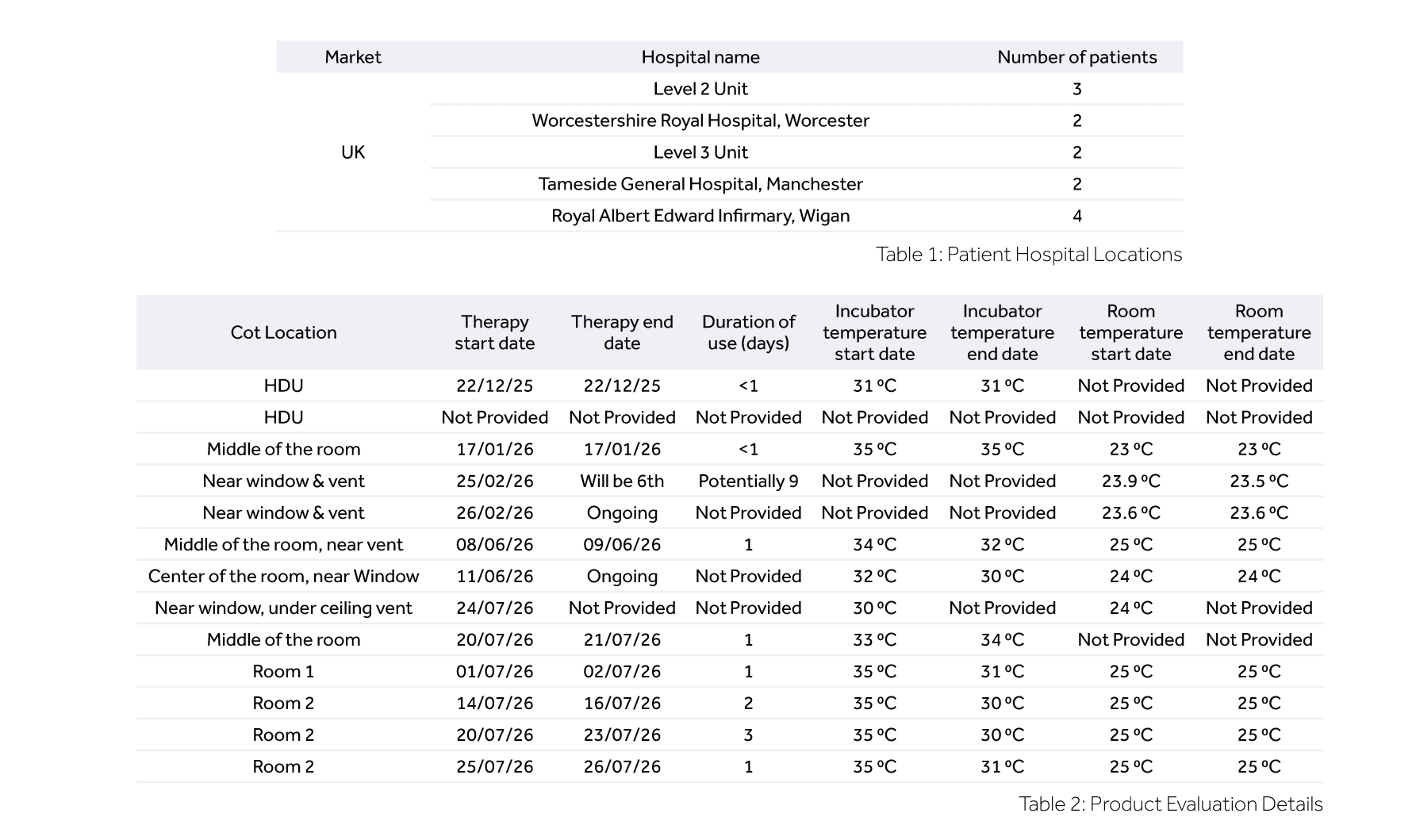
Thirteen evaluation forms were received from five UK hospitals with variable data completeness (Table 1). The evaluations were conducted between 22nd December 2025 and 25th July 2026, with the completed evaluation forms received between 22nd December 2025 and 3rd August 2026.
Evaluation Environment Details
Five cot locations were at or near a window and/or air vent (38%). Two cot locations referenced the middle of the room (15%). The remaining responses (n=6; 46%) identified the hospital room number only, rather than the cot position within the room.
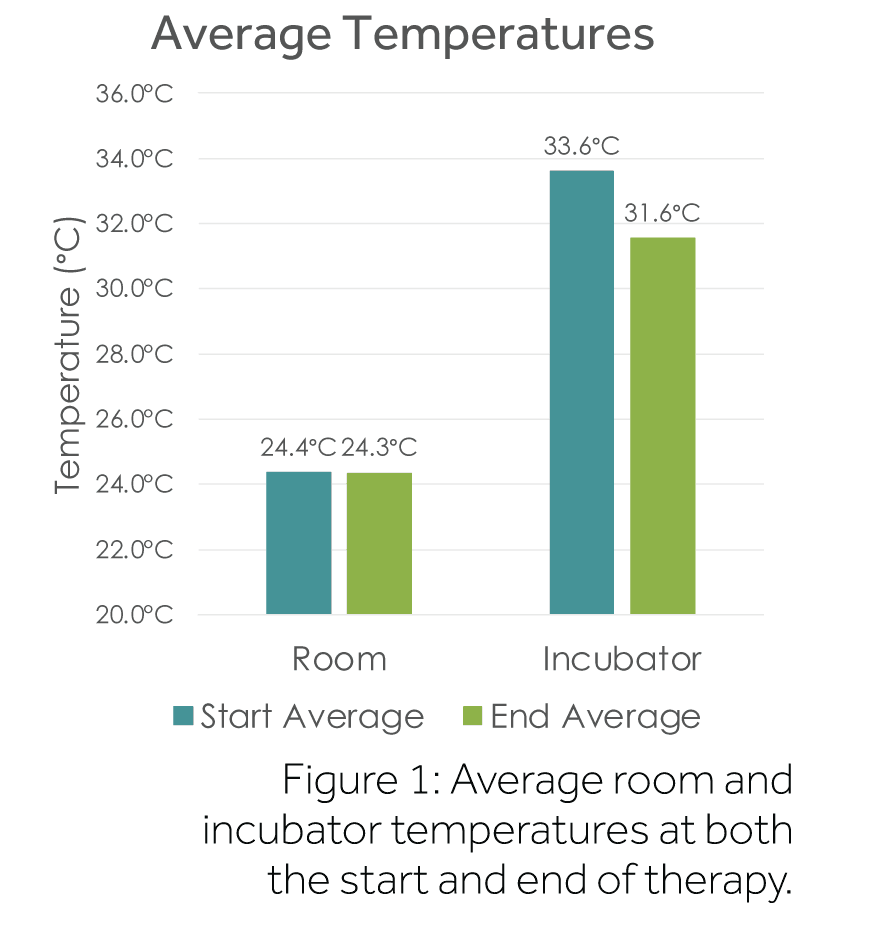
At the start of therapy, room and incubator temperature were not provided for three evaluations (23%). At the end of therapy, room and incubator temperature were not provided for four evaluations (31%). From the forms with completed information, room temperature data was recorded between 23 – 25°C at both the start and end of therapy. The average room temperature change was minimal, with a difference of -0.1°C across the evaluation period. Incubator temperature data was between 30 – 35°C at both the start and end of therapy, with an average temperature difference of -2.0°C from the beginning of the evaluation to the end. Average temperatures are shown in Figure 1.
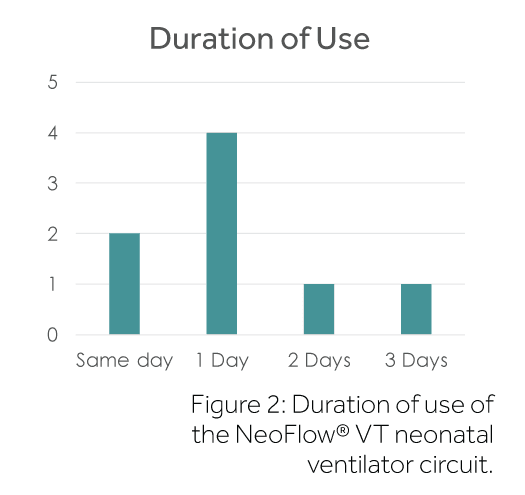
The duration of use ranged from same-day use to three days (Figure 2). Two evaluations were recorded as same-day use (25%), four as one day (50%), one as two days (12.5%) and one as three days (12.5%). Although ongoing, one form indicated that their expected duration would be 9 days, despite being longer than the recommended usage duration of 7 days.
All evaluation location, temperature and duration details are summarised in Table 2.
Circuitry Set Up
When asked whether the circuit was easy to set up on the patient, 100% of respondents with valid responses selected “Yes” (n=11). Two forms did not contain a response to this question.
Water Condensate Accumulation
The second question asked: “Whilst using this NeoFlow® VT circuit did water condensation build up within the tubing?”. Of the eleven valid responses received, 100% selected “No”. No respondent selected that water condensation had built up within the tubing.
As no valid respondent selected “Yes” to water condensation build up, the follow-up questions relating to condensation timing, amount of water accumulation and whether the level of water build up would stop product use were not applicable.
Therapy Type
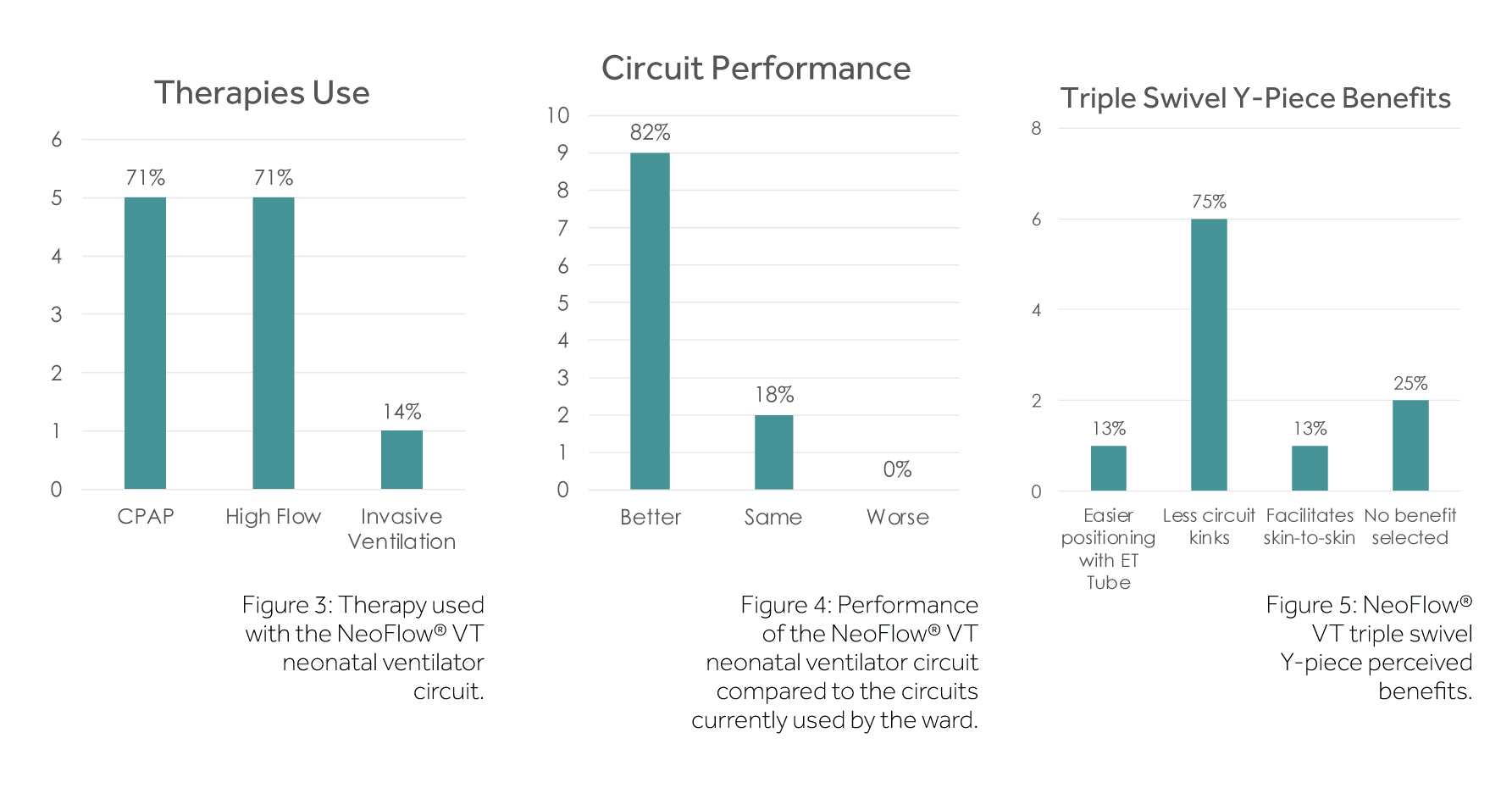
Where therapy type was recorded, the NeoFlow® VT circuit was used for both CPAP and High Flow, with each selected on five of the seven valid responses. One form also recorded use during invasive ventilation. Therapy type was not recorded on the remaining six forms; however, on five of these forms this question was not included. The results are shown in Figure 3.
Current Circuitry Provider Comparison
Eakin Healthcare was identified as the current circuitry supplier in seven responses, while Fisher & Paykel Healthcare was identified in three. Supplier information was not provided in the remaining three evaluations.
Where product references were provided, two Eakin Healthcare users referenced AMVC1775-203 and four Eakin Healthcare users referenced product reference AMCP1409-037. Fisher & Paykel references included RT265 and an Optiflow™ circuit.
To compare the NeoFlow® VT circuit performance to circuits currently used on the ward, respondents were asked how the NeoFlow® VT circuit performed compared to previous circuits used (Figure 4). Of the eleven valid responses received, 82% (n=9) selected “Better” and 18% (n=2) selected “Same”. No respondents selected “Worse”. All seven respondents currently using Eakin
Healthcare circuits rated the NeoFlow® VT circuit as performing better. Two Fisher & Paykel users also selected “Better”, while one Fisher & Paykel user selected “Same”. One respondent with an unknown current circuit provider also selected “Same”.
Circuitry Benefits
When asked if they felt that the inclusion of antimicrobial technology in NeoFlow® VT was beneficial, out of the seven valid responses, three respondents selected Yes (43%) and four selected No (57%). This question was not included on five forms, and in one further response it was included but no answer was provided.
Out of 8 valid responses on the benefits of the triple-swivel Y-piece (question was not included on five forms), one response felt that the Y-piece provided easier positioning of baby while maintaining a fixed endotracheal tube (13%), one felt that it helped to facilitate skin-to-skin safely (13%) and six felt that there were less circuit kinks with the independently rotating limbs (75%) (Figure 5). Two responses did not select a benefit and therefore are assumed to mean that they felt none of the three provided benefits were relevant to the NeoFlow® VT circuit.
General Product Feedback
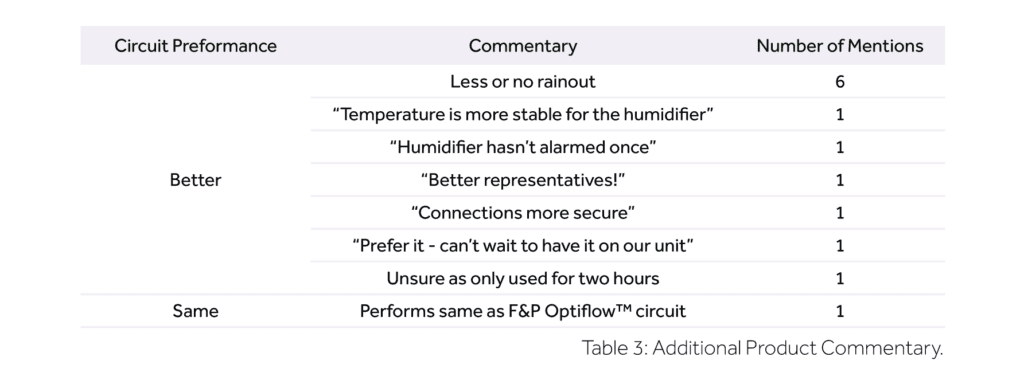
Additional commentary on the NeoFlow® VT circuit, categorised by circuit
performance, is provided in Table 3.
Conclusion
Primary Objectives
- Identify the level of water condensate accumulation within the NeoFlow® VT inspiratory tubing across 7-day single patient use.
- Identify the length of time until water condensate accumulation within the NeoFlow® VT inspiratory tubing across
7- day single patient use (if applicable). - Gather information on the cot location, room temperature and incubator temperature throughout the NeoFlow® VT circuit use.
- Assess whether the level of water condensate accumulation was acceptable to continue NeoFlow® VT circuit use (if applicable).
Overall, the NeoFlow® VT ventilator circuit received positive feedback across the five participating hospitals in the evaluation. The absence of reported condensation suggests improved condensate performance with the new helical wire component. This should be interpreted in the context that most recorded evaluations were completed over shorter periods of use and primarily involved non-invasive therapy modes. Notably, favourable condensate performance was also reported in bedspaces that may be more prone to condensation, such as those near windows or air ventilation systems.
Secondary Objectives
- Evaluate the ease with which a user can set up the NeoFlow® VT circuit.
- Compare performance of NeoFlow® VT to ventilator circuits currently used on the ward.
- Assess NeoFlow® VT benefits.
- Gather general product feedback.
User feedback relating to the secondary objectives was favourable overall, with all respondents confirming that the circuit was easy to set up on the patient. Comparative performance feedback was also favourable, with most respondents rating NeoFlow® VT as better than the ventilator circuits currently used on the ward, and no respondents rating it worse. Feedback regarding antimicrobial technology was mixed, suggesting that this feature may require clearer communication of its intended benefit. General product feedback was positive overall, including comments that the circuit produced less rainout.
In conclusion, the UK evaluation indicates that the NeoFlow® VT ventilator circuit performed well in neonatal clinical use, with no reported condensate build-up and favourable user feedback on set-up and performance.
Profile
Roanne Lecky
Product Management Executive
Lindsay McQuillan
Senior Product Manager